
Monsoon morning diary notes

Updated: Jul 28
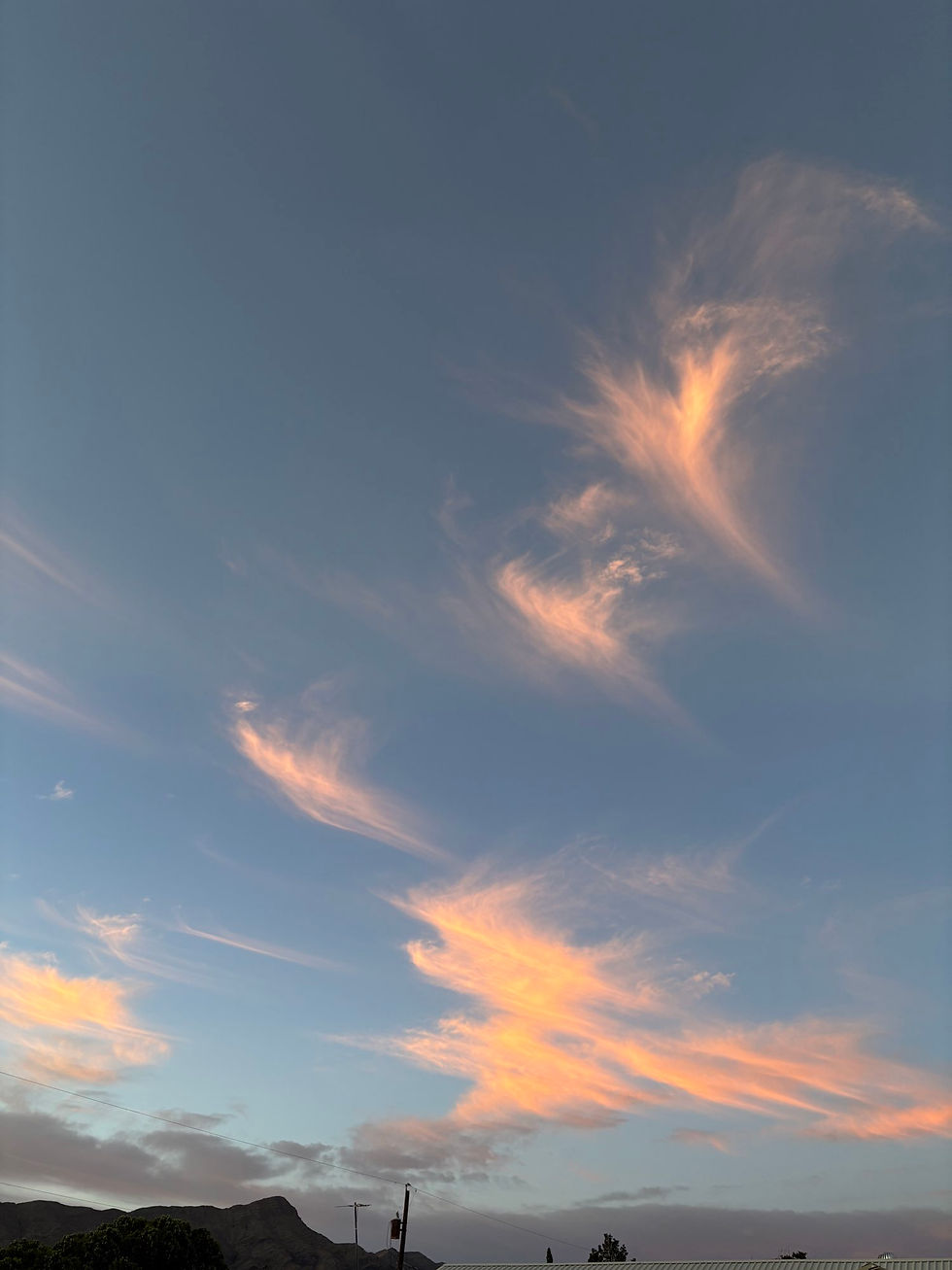
There are a myriad things I love about living in this enchanted desert. Monsoon mornings are one of them.

Days are once again sultry, sweaty and buzzy with bugs.

Clouds form, big and puffy rumbling with thundery promise. Though some nearby places have been devasted by roiling floods, in this little piece of northern Chihauhauan desert those heavy clouds seldom deliver more than a spatter of raindrops. Sometimes one sees charcoal smudges of virga - when the sky releases rain but it evaporates before it gets to the earth. There’s been maybe as much as a tenth of an inch a scant three times so far. Every drop is worth recording and celebrating, though.

Evenings might even end with a light show.

The garden is in a summer overgrown and unkempt funk. It’s too hot and buggy to spend much time with it these days. It’s again the time of year when I wonder why I garden. Because of the serious drought we have municipal water restrictions which limit garden watering to three days a week, allocated by street number, before 10:30 in the morning or after 6 pm at night.

On the days when I’m not watering the garden, I mostly take long neighborhood walks in the cool predawn, leaning into the magic, scattering bouncy hoppity cottontail rabbits as the light comes up.

I’m not doing much prayer paddling at dawn. Enchantment is elsewhere. With irrigation release following a serious winter snow drought in the catchment area, the lakes are historically low - that’s 1% capacity for Elephant Butte this week. Unless you are an archaeologist fascinated by late 20th century human middens, it is neither magical nor enchanting out there. Decades of silt and human debris is surfacing. So many cell phones of all vintages! Keys. Beer cans. Liquor bottles. Car tyres. Metal stuff and chunks of concrete - as an aside who is dumping their construction waste in the lake? The human remains are a closely guarded secret. With respect. This lake did flood villages and burial sites when it was built 120 years ago and then there are the Toy Box killer stories. The state parks administration has brought in earth moving equipment to attempt to clear safe corridors for boating folks but even at dawn it’s ugly, smelly and super scummy with toxic algae bloom in the shallows. In my mind it would be like paddling in the stagnant crater left behind after the end of the world. However that happens, banging or whimpering.

So I find my morning magic on foot, basking in liminal light with the cottontails, breathing in the desert dawn.

Some mornings I luck out and there’s been a rain shower the night before, releasing the metallic petrichor- the creosote bush (Larria tridentate) smell unique to this area.

After one of these rare rains, the desert flora glistens and sparkles with monsoon moisture. That said, the drought is serious. Even the native opuntia cactus are showing heat and drought stress, but oh! the resilience, the determination: they are still producing magical orbs of jewel colored tuna. I’ve just started harvesting prickly pear cactus fruit, using these precious gifts from the desert mostly for juice . I find the seeds quite gritty with a tendency to stick in my not-so-young-anymore teeth. After pressing the fruit pulp through a sieve, I dehydrate the seeds. They can be ground into a high protein flour to add to pancakes and muffins.
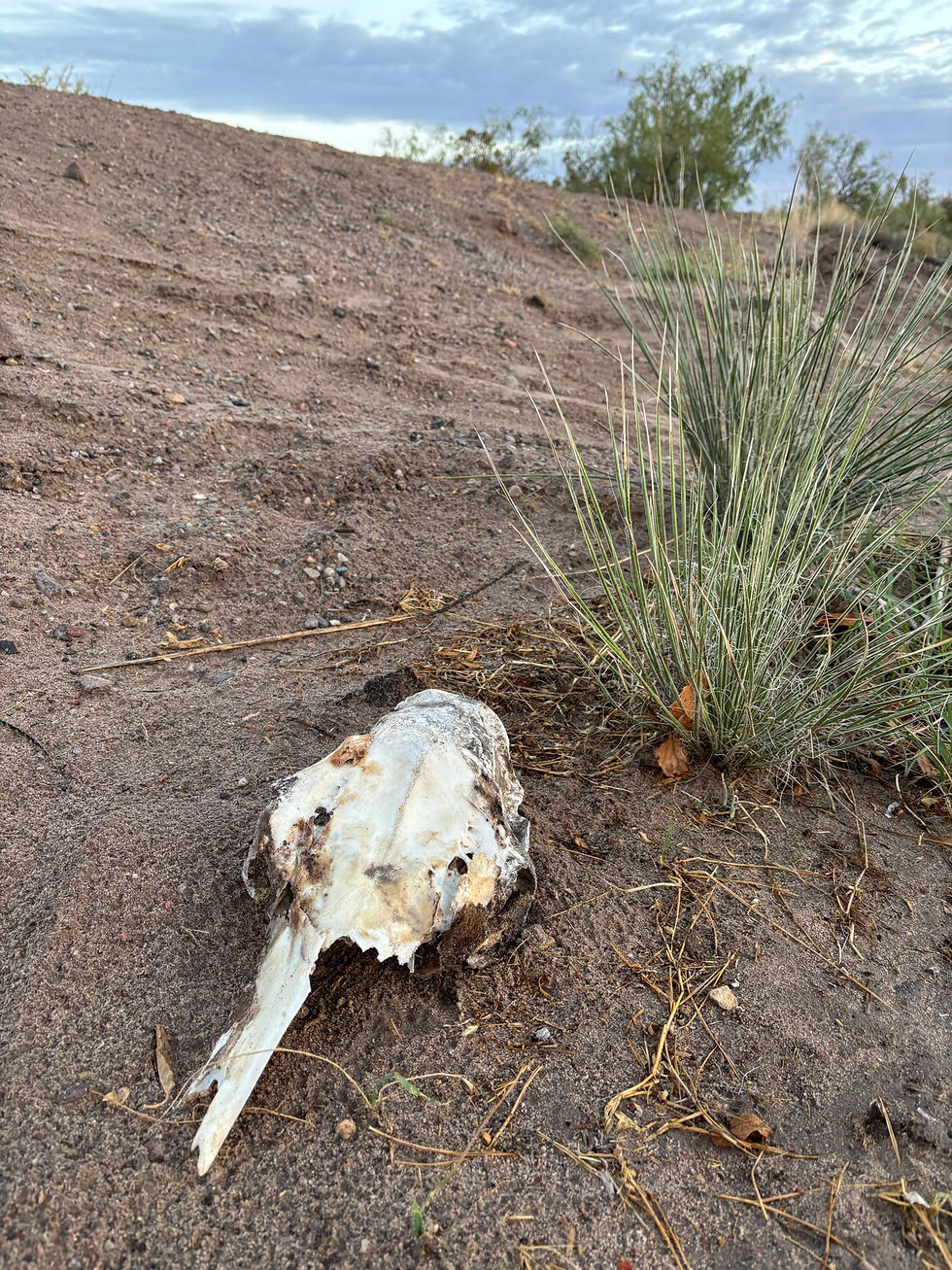
One morning I encounter a partial skull alongside the path I am walking. The desert is good at bleaching bones.

In this way I walk myself to peace, under quietly magnificent sunrise skies.

Occasionally I meet other early risers. This curious sentinel, incidentally, seems to live at (want to escape from) the campaign headquarters of a local politician.

I do hope Jim takes better care of his constituents than his white turkeys. If they are not one and the same. **

The jokes write themselves these days.

Just up the street from the shala, a fantastical flock of crowing cockerels bears witness to comings and goings of the neighbourhood.

Me too. Though I don’t do it with a loaded gun as the metal cocks do. The pen will always be mightier.

Thus said the turkey.
**Note: a brief internet search seems to indicate that James L and/or Jim Russell is/are no longer living.
Recommended Reading:
A Flower Travelled In My Blood: - Haley Cohen Gilliland, 2025. The blurb on the front of this Pulitzer finalist tells us this is “the incredible story of the grandmothers who fought to find a stolen generation of children”. They had me at “grandmothers”. I had no idea what I was taking on.
While for the past six or seven years my doctor at the local rural community health clinic was from Argentina, a country I could vaguely place on a map of South America (thanks mostly to my lovel of travel writing and Bruce Chatwin) and I know they play a great game of soccer (football to some), I confess I didn’t know much about Argentina’s history.
Sadly my Argentinian doctor retired (I now have a Brazilian nurse practitioner as a primary care practitioner) but thanks to this amazing feat of research and storytelling, I
now have a slightly better knowledge of the recent history of the country. I know, for example, that during some recent authoritarian regimes, protesters disappeared. Only later, much later, did the horrific, cruel and inhumane methods used to erase people who opposed the regime come to light. While adults were abducted then murdered, the regime claimed “We do not kidnap children” which actually translated into “we sell babies”. Through persistence and advances in genetic research, a small group of grandmothers, the Abuelas de Plaza de Mayo, searching for their disappeared children and grandchildren, unraveled mysteries, exposed secrets, lies, corruption and terrible acts of torture and death, and found some of the missing family members. Most were living under different names, had no idea of their origins after being adopted into families supportive of the regime. Genetics, especially research into “mitochondrial Eve”, the ancestral maternal mitochondrial marker, the flower travelling in our blood, helped to reveal the truth, finding a measure of justice for some. We celebrate victories for humanity and science as we read about the exposure of a horrible history.
…When will we ever learn…


Comments