
Molested by flowers, feeding on dew and stardust


In the first week of September I meet the tail end of the dramatic flowering of a couple of Agave havardiana (Havard’s agave) at the entrance to the Santa Fe Botanical Gardens.

Actually, when I look closer, these very tall flower spires seem to be more at the fruiting/seed pod stage, with flowers already done.

I’m not really sure exactly how old these two lovely, sculptural, asparagus relatives are, but it would probably be between 20 and 40 years. Their work for this lifetime is now done. Agave havardiana flower once in a lifetime and then die. While the flowering typically doesn’t happen quite once a century, one of their common names - Century plant - references this feature of the species.

The agave plants stand at the back of what I am calling a bundled stick installation (I failed to record the artist and/or the feature’s given government name) making interesting scribbles against the impossible blue of the enchanted sky, with echoes in shadows cast below, streaking the sandstone paving and a conversation nook gathering of benches.

It was early in the morning, just after opening, and watering time in the garden, so I had to watch where I stepped in this area made wonderfully colourful by massed plantings in big ceramic pots.

Bees were really buzzy in these beautiful displays.

Potted gardening might be my personal nemesis, but I am beginning to appreciate how the professionals use them for dramatic seasonal display, especially in public spaces.

In skilled hands, container gardening can be impressive, but, in my opinion, it is a high maintenance branch of horticultural arts, needing just so much extra care, feeding and watering daily.

I believe I found a Bombas sonorus (Sonoran bumblebee) enjoying (molesting) what is probably a cultivar of rambling Rosa rugosa. Note to self: consider introducing rambling roses into the paradise that is the Garden of Earthly Delights.

After the untidy bird’s nest stick installation, I followed a cottontail rabbit through rose and lavender borders into the orchard.
Unfortunately just as I was focusing my camera on the rabbit, some unaware employee of the establishment walked into the area speaking very loudly about electrical outlets (yes who shouts like that in a garden in the early morning?) scaring the bunny completely away. May employee with serious lack of situational awareness learn that if one is disrespectful and unnecessarily noisy around certain plants and in certain gardens, one runs the risk of backing into a cactus or tripping and falling into a bed of nettles.
Luckily for me, salve for my irritation was right at hand: deep breathing yielded the scent of roses and lavender, two really beautiful and powerful plant essences. If it weren’t for loud and obnoxious employees doing inexplicable and non garden related things very loudly, this orchard meadow would be another lovely area to spend time in contemplation.

I moved on, though, to admire the skillful displays of colour and form which transition one from the meadow area to the xeriscape.

The prickly and the spiky nestle between lovely tumbles of rocks.

I am smitten, again and again by these desert denizens and their drought tolerant cousins. True desert roses. They have my heart.

This botanical garden takes it’s educational mission seriously and thus has some great signage. Which print addicted me read, of course.

Though I’m not really sure all of it still holds true. The last two years might have made a little bit of a difference to some of these statements.

There is a historic red metal bridge over an arroyo to cross over before one arrives at the ethnobotanical section with its amphitheater for lectures, ceremony and such.
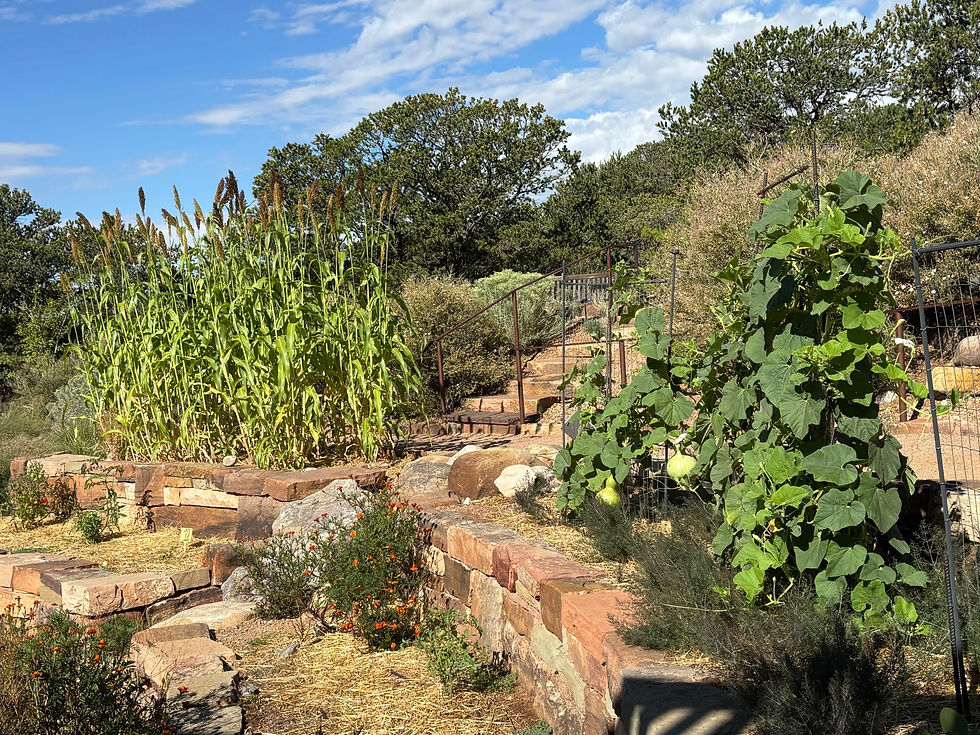
The area is embraced by tiered planting spaces for food and medicine gardens. Late summer is peak Southwest harvest season. Curvy bushel basket gourds hang heavy and lovely on vines. So voluptuous!

A healthy stand of Sorghum bicolor reaches for the sky, reminding me that I want to grow this ancient grain which is a relative of maize and millet. Maybe one day I can even make myself a broom with the stalks. Unfortunately the Summer of Abandonment at 6th Avenue Shala has left me with just a single somewhat challenged plant to show for the 2026 attempt, nothing like the ones I encounter here.

Amaranth and sunflowers dance their own harvest celebratory ceremony with the morning sun.

A mosaic at the back of this ethnobotanical amphitheater honours the Southwest’s traditional Three Sisters.

Of course sacred Madame Moonflower is there too. No Southwest ethnobotanical gathering would be complete without Datura wrightii , attendant ants and all.

There was a sign about Madame Moonflower too, just as there was in the hortus I visited in the Netherlands in August. I did notice, however, that the botanical name listed on this Sante Fe Botanical Garden sign is Datura stramonium not that of the Gracious Lady of the Night (Datura wrightii) whom I live alongside in the enchanted northern Chihauhauan desert. Curiouser and curioser. It seems there are two who claim to be sacred. Isn’t that always the way: many paths, many mansions.

Madame Butterfly kept her counsel on these matters.

I had an appointment with some Ghanaian death cabs at the Museum of International Folk Art so I headed back to the exit, leaving the ramble through the 3.5 acres of juniper and piñon woodland for another day and passing some more dramatic potted displays, one of which included a very interesting grass.

I came to this garden on this day, not just to experience Santa Fe Botanical Garden in full summer bloom, but also seeking a place to dissolve a little bit of the mundane which weighs on me. I came seeking to be molested by flowers, yes, but also to be fed by dew and stardust.

Briefly, out of the corner of the eye I might just have caught a glimpse of the crack where the light gets in.

It’s a lifetime’s work: finding light. Illuminating luminosity.
Radiance.


Comments