
Dreaming in fields of flowers

Updated: May 22
Out beyond ideas of wrongdoing and rightdoing,
There is a field. I’ll meet you there.
When the soul lies down in that grass,
The world is too full to talk about.
Ideas, language, even the phrase each other
Doesn’t make any sense.
Jalāl al-Dīn Muḥammad Rūmī 1207-1273.

If you build it, they will come
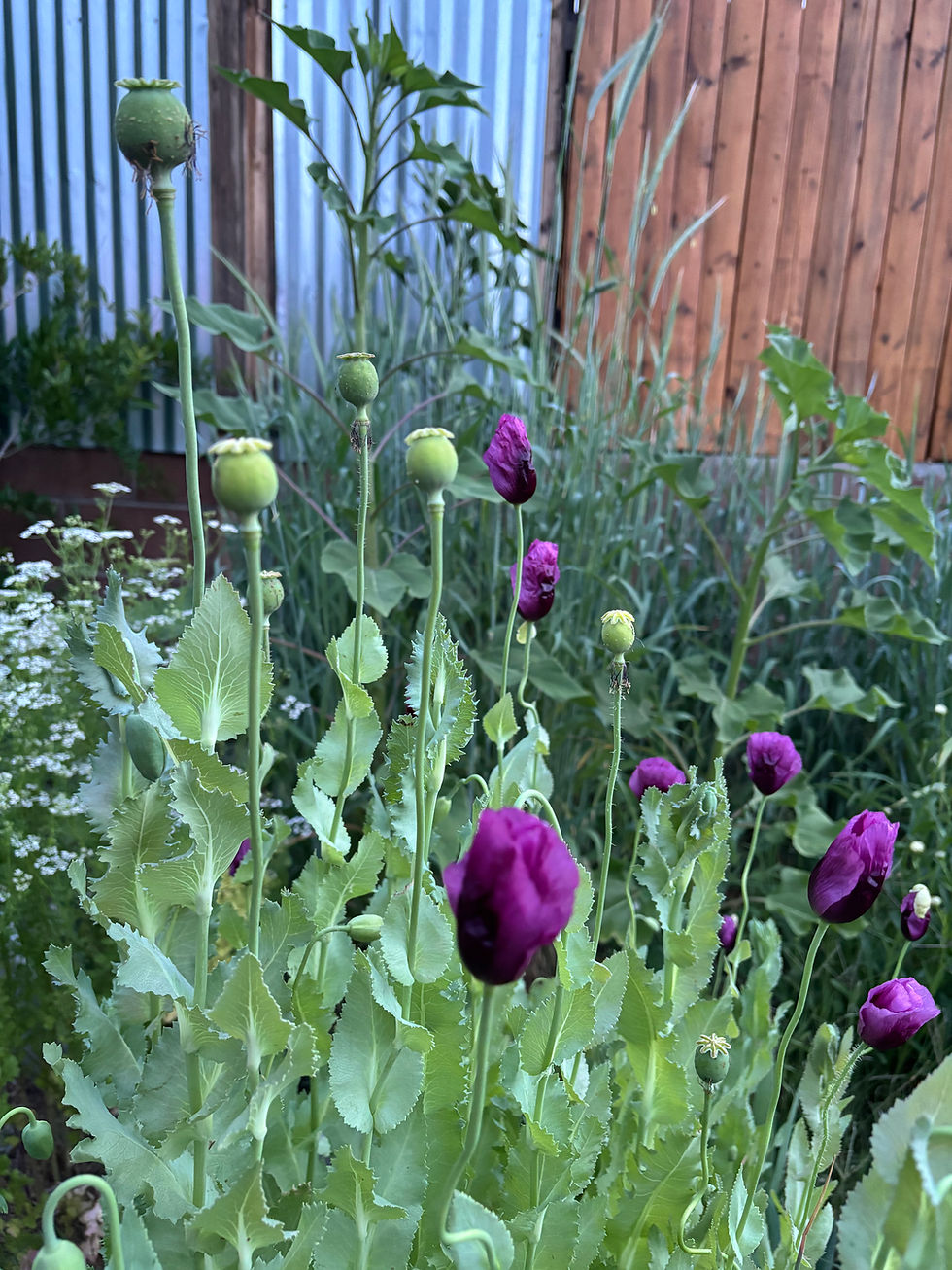
Every day now, I walk out into a field of flowers.

My ongoing pursuit of black flowers manifested this season in a patch of Black Peony poppies (Papaver somniferum) .

Not quite black but very poppy.
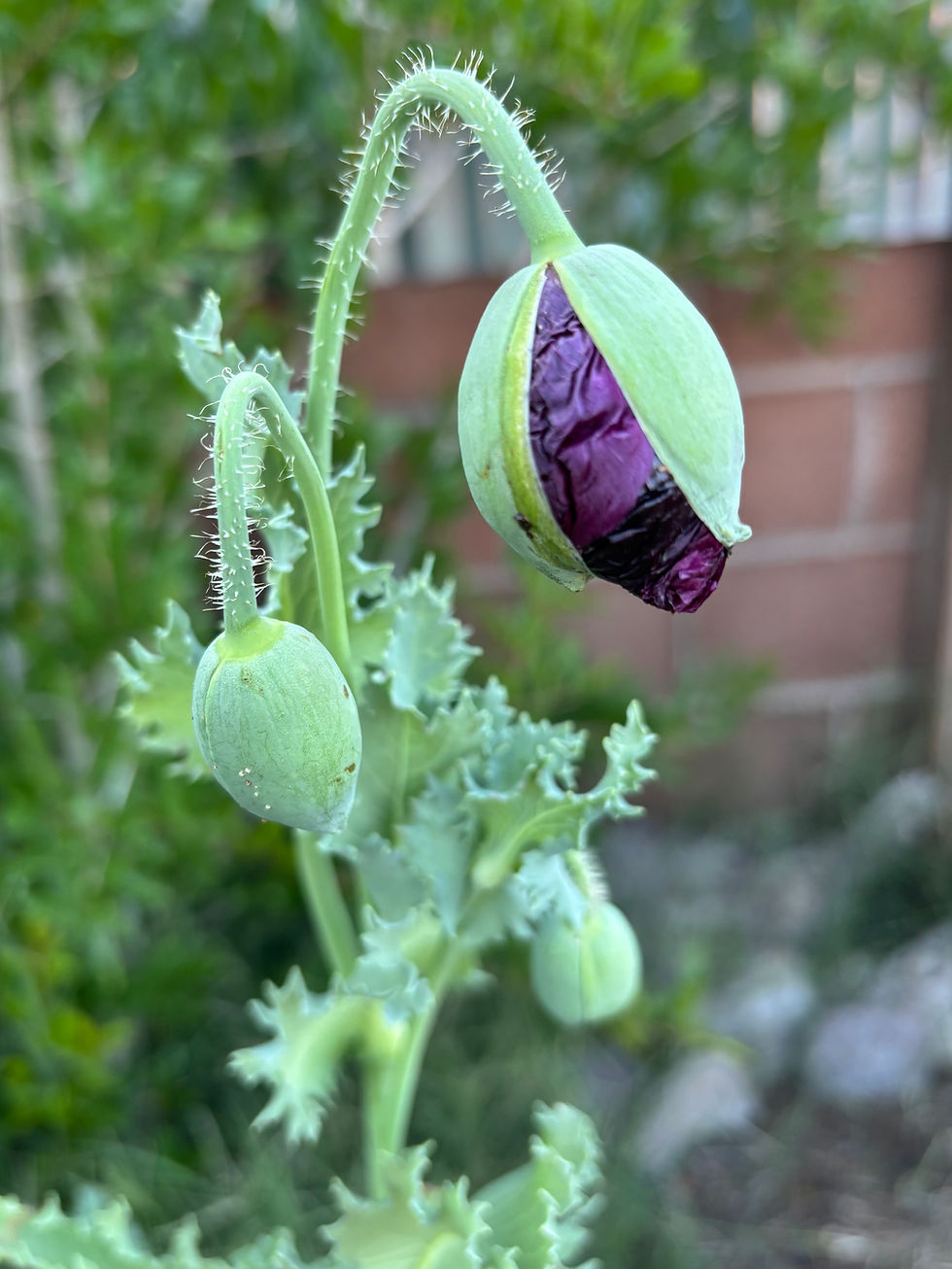
Even when folded tight.

Pollinators love them. Especially the single petalled ones. There’s quite a range of petal shape and colour, some artfully tattered by design. A beautiful variation on the poppy theme: dark, evocative, romantic.

The very crinkly full blooms, however, are hard for the pollinators to get into.

I have to take care walking some of the pathways through the garden at certain times of day.

Honey bees have set up housekeeping in one of the compost bins. Again. Deja vu. They did it last year too. Is the garden telling me it wants a bee hive?

At certain times of day, the honey bees have a tendency to zoom straight into me if I get between the hive/compost bins and the flowers they are loving. Honey bee GPS systems seem to be pretty rigid. They are as set on their flight paths as autonomous cars or jets in the air traffic uncontrolled skies over a certain country. Jata are definitely not bee friendly. The possibility of a human head wandering into a honey bee flight path does not seem to be in their current programming. If I hung around more, maybe they would update but I’m not going to test the theory. One bee tangled in my jata is one too many.

A sunflower bioremediation project is currently also blooming grand. Last winter when I was looking for more food garden planting space, I suspected motor oil contamination in this neglected area at the far north east corner alongside the wash line.

I read that sunflowers could help to extract the heavy metals. Then I remembered a dusty bottle on a high pantry shelf containing Helianthus annuus seeds saved from various gardens I’ve tended in the past decade or more. I took down the jar and emptied it alongside the transplanted root cuttings of Helianthus maximilliani. I didn’t think many would germinate - some were more than 10 years old. Every now and then I gave them water and then more regularly as it warmed up.

The results are interesting and threatening to cramp my washline style for the next few months. Germination rate was somewhat better than I expected. Oops. Oh ye of little faith.

At some stage I had sown some seeds of chocolate or mahogany sunflowers in a garden somewhere, and gathered in the seeds, added them to that dusty jar.

My horticultural advisor, The Last Emperor, once cautioned against planting a bird attracting fruit tree near a washing line. Oh dear. Seedeaters might not make huge purple splodges like birds gorged on ripe plums, but I think I am going to need to be examining my freshly printed cloths much more closely this summer. The palila (Loxioides bailleui) in the above prints is an endangered species of Hawaiian Honeycreeper endemic to the slopes of Mauna Kea and has a mutually beneficial relationship with the māmane tree (Sophora chrysophylla) whose berries and leaves can also be seen in the design. Though palila have a finch beak, they are probably not going to be feeding on sunflower seeds. But one can hope. Albeit symbolically.

If you look hard, you will see a fuzzy buzzy bumble bee (probably Bombas sonorus) in the top left sector of this image.

Here’s a slightly better image of a Bombas somebody or other visiting last year’s black flower hollyhock project. Interim report: after more than 20 years of part time attention to this black flower thing, most “black” flowers are closer to deep red or deep purple than black. It depends on who is doing the looking and how. Colour is subjective and relative. Supremely. A construction of light or the lack thereof, reflective sometimes, like the moon.

This carpenter bee playing rough with a flimsy cosmos flower, did not like having its picture taken. Just after this shot, they flew straight at my face, hitting me on the forehead, effectively telling me to buzz off.
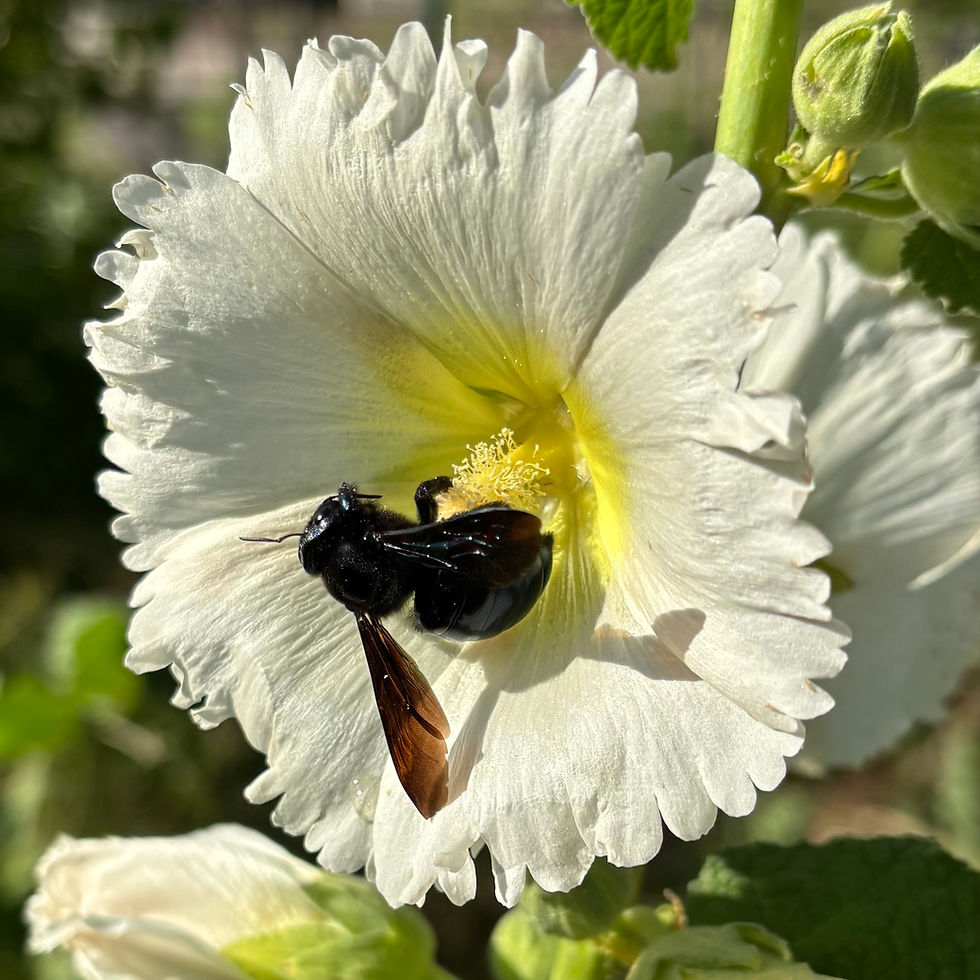
I caught up with them, or their cousin-brother at a hollyhock out front.

My friend Bombas sonorus was visiting there too.

It’s not all days of pollen and nectar (wine and roses) though. Garlic harvest has begun.

Beetroot have all been pulled and peas are coming to an end, producing reasonably given the heat. I’ve dined well on them for weeks now.

Rye (Secale cereale) has a week or two more before I wield the scythe.

Green tomatoes are beginning to swell. I’m especially gratified to see that the Korean Long paste tomatoes do indeed have a hook nose, as promised.

I caught the tail end of a cactus wren at the kitchen window birdbath this week. Hello Cactus Wren!

Paradise

A walled garden.

If you build it they will come.

Seems I made a Cafe Paradiso for pollinators.

The birds and the bees and me in the mornings, watering, with the scent of yucca flowers on the air.
Recommended Reading:
I lost and found myself in a magnificent novel this past week:
This Is Where The Serpent Lives by Daniel Mueenuddin. 2026. Set in contemporary feudal Pakistan this novel has a wonderful, complex cast of characters navigating wonderful, complex lives as best they can through the morass of morality, power, culture, caste, corruption, brutality, materialism, duty, loyalty. Playing the hand they are dealt.
Playing the hand.
Read it and think about it. The power of story. The powerful story. Write it. Live it.

Become a Desert Bird of Paradise.

Comments