
Garden touring, European edition. Experiment : be earth!

“I am convinced that the growing impoverishment of symbols has a meaning. It is a development that has an inner consistency. Everything that we have not thought about, and that has therefore been deprived of a meaningful connection with our developing consciousness, has got lost…. it would be far better stoutly to avow our spiritual poverty, our symbol-lessness, instead of feigning a legacy to which we are not the legitimate heirs at all. We are, surely, the rightful heirs of Christian symbolism, but somehow we have squandered this heritage. … Anyone who has lost the historical symbols and cannot be satisfied with substitutes is certainly in a very difficult position today: before him there yawns the void, and he turns away from it in horror. What is worse, the vacuum gets filled with absurd political and social ideas, which one and all are distinguished by their spiritual bleakness…” Carl Jung, “Archetypes and the Collective Unconscious” (1934)

Jung wrote repeatedly about the need to lead the symbolic life as an antidote to modern neurosis brought on by a literal, rationalistic orientation to existence. I cross the threshold, in a place called Bergen, I believe. Purple hibiscus attends.

Rain spattered purple hibiscus (probably Hibiscus syriacus) speaks meaning into my silence. Provides the bouquet to carry me into my date with destiny, the crowning of my croning. So there’s that. At least. Purple hibiscus.

But I get ahead of myself. Or lost in the interior monologue.

I had asked to see gardens during my time in the Netherlands and, yes, I saw gardens. Everywhere. Sometimes accidentally.

There was this one which incorporated complex and creative bug motels to support and attract pollinators and other helpful insects.

When I encountered this little piece of the Netherlands and it’s very creative steward, I was not many hours on land and delirious from disorientation in time and space, after more than 24 hours in transit and tortuous confinement. I met the gardener’s goats too.

It seemed a fairytale fantasia made real.

With accompanying moral. Of course. Fade out supplied by a setting sun (by way of apology for terrible picture). There is no other time but this moment, this now. No returns. No do overs. We take more than we give. Uh huh. True that.

Long before my late life experiments with small scale grain growing, I’ve long wanted to meet a korenwolf, that legendary spirit of the grain fields. The korenwolf is invisible, making itself manifest in the movement of wind rippled grain fields, and is the spirit in the last sheaf standing after harvest. When at peace, korenwolf brings fertility but when angered, the spirit can destroy harvests and capture and eat children. “Don’t go wandering off into the mielie fields”, I was warned as a child who had the run of hundreds of acres of farmland, “or korenwolf will get you.” Depending on your imagination, the spirit can have six legs and a ferocious wolf aspect, or present a benign hamster visage, as in the above beer logo - the nearest I’ve come this lifetime to meeting a korenwolf in the flesh (or metal) so to speak. It’s not for want of trying though. I’ve done a bit wandering in forbidden grain fields in my time. Uh huh.

At Wimmenummerduinen, a dune reserve with a kind of outdoor museum, historical section, honoring and continuing the allotment tradition of small scale subsistence agriculture, I walked a trail through some of the North Holland dune fields. It is a fascinating area of strange and slightly fuzzy beauty and one of the few places I saw some slight curves in the land/dunescape. On my visit, the plants, as elsewhere in the Netherlands, seemed to be showing signs heat stress and scorching from the summer’s punishing, extreme heatwave. My attention was elsewhere though, due to lack of sleep, cultural, geographic and national overwhelm, and other more deeply personal stuff clamoring too loud in my head. I feel that maybe I wasn’t as present as I could have been for the dune walk. I would definitely want to revisit the place when I’m in a different head space. Probably often, in all seasons, to fully breathe its spirit. I’m grateful I walked my feet here briefly, where other small scale agrarian people have had their hands in the earth. However unconsciously.
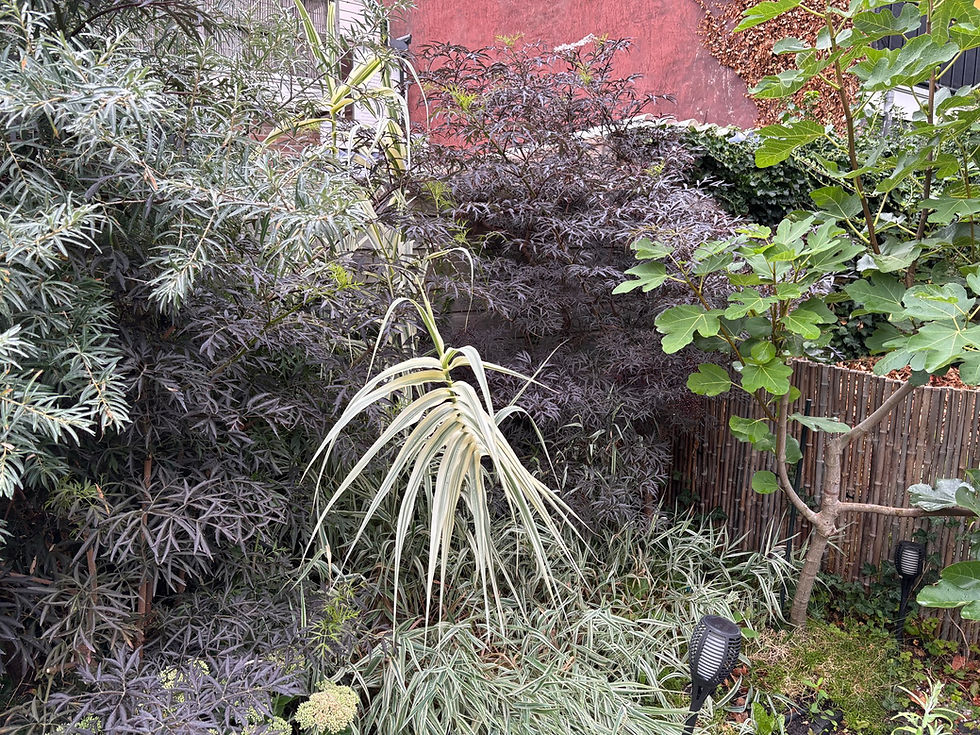
I was more present when I was shown a small urban backyard garden designed and maintained by my own personal horticultural advisor, the Last Emperor himself.
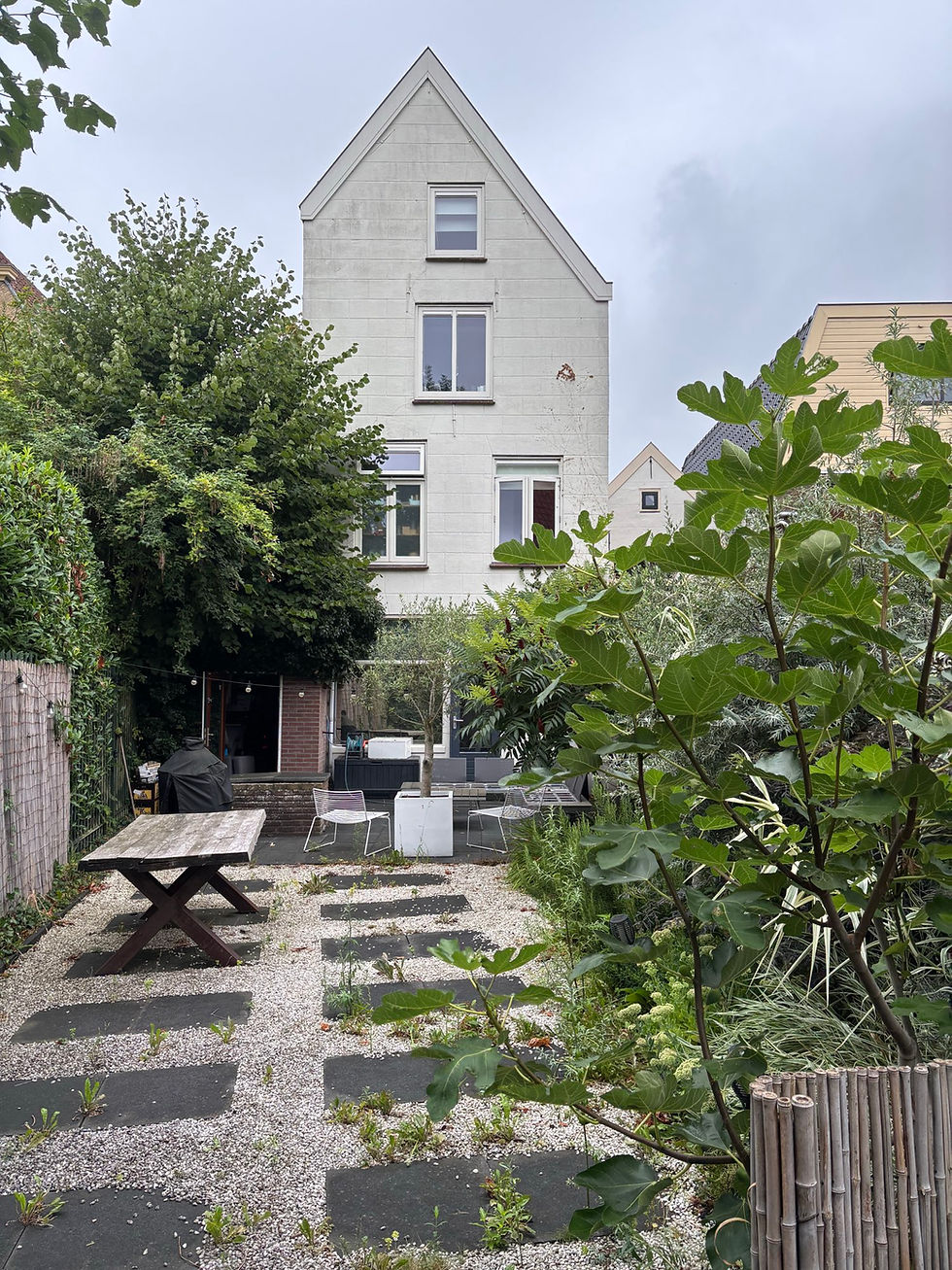
It was a spur of the moment visit when we were doing a wander the streets of Alkmaar and drink coffee town day thing, so the garden had not been prepared to be shown. The Last Emperor did not design nor lay the paving and gravel work. Again, as can be seen in the tall narrow building accommodating a shop and living quarters attached to this garden, I experienced the Netherlands as a place of amazing and interesting architecture. And small spaces.

Though they are the backdrop to a private urban leisure and recreational space, the plantings were what I had come for. In their variety of colour, shape and form I saw both the hand and eye of the creator, and the eye of storm, that calm and yet oh so dramatic place where we can come to stillness, be restored, revived, refreshed, created anew. And created again. Eternally returning. Plants have purpose. Always. Every day.

And this garden’s own korenwolf, showed itself. Of course it is feline.

What a beauty!

Speaking of plants and purpose, I also visited a hortus which is a form of botanical garden where plants are collected and presented, most often for preservation and educational purposes. Unlike some botanical gardens I’ve visited in several different geographies, which have been park like open spaces, the hortus I visited in the Netherlands was mostly concrete walkways between massed beds of a single plant or collection of plants, with slightly erratic labeling. The term hortus is derived from the Latin language, and has meaning associated with garden enclosure.

The enclosed or walled garden, the garden room, or paradise resurfaced, repurposed (but not as a parking lot). Yes, I did slip off my shoes and walk barefoot on that grass, just as I had done the day before walking barefoot feet in the ocean at a beach somewhere after the purple hibiscus threshold. Earthing myself comes naturally, instinctively, even when there aren’t signs to tell me what and why.

Speaking of signs, this hortus has solved a public toilets problem which so many little minds seem to wrestle with in the USofA. What was it that Jung said (quote in header above) about the vacuum getting filled with absurd political and social ideas?

Then there were The Gardens At Peaky Burgers which I wandered through several times a day during my brief European excursion, since they were at the parking lot and entrance to the canal and harbour when my host and his fleet of boats hang out.

Peaky Burgers, the food vending business, was actually closed for a week or two while I was there so this is not a review of that establishment. Though the gardens and seating were looking a bit unkempt, I saw evidence of the plants being cared for on a daily basis.

Planters, even big pots, are not my personal favorite form of gardening. Roots get hot, dry, cramped, cut off from underground communities, in my opinion and experience. But then I do currently tend a garden in a very hot, mostly very dry place and I’m a big fan of underground community connections.

Some professionals, however, have an eye and hand with the contained format, challenges notwithstanding.

I see you.

I applaud you.

Even when the fire is low.

Your legacy. My heir. Our heritage
How should Spring bring forth a garden on hard stone? Become earth, that you may grow flowers of many colors. For you have been heart-breaking rock. Once, for the sake of experiment, be earth! Jalāl al-Dīn Muḥammad Rūmī, 1207-1273

Recommended Reading:
Land by Maggie o Farrell, 2026
An enduring story not just for these times but for all time about the maps we make and remake, colonization a nd rebellion and a love song to the sanctity of land and open spaces. A wondrous engrossing experience all the better, for me, to experience in audio format with those wonderful Irish accents adding a dimension.
Purple Hibiscus by Chimamanda Ngozi Adichie, 2003. Yes, it’s older now, but this author’s first novel exploring the legacies of colonial Nigeria is one I often reread and recommend before Half a Yellow Sun (2006) which is more well known since it was made into a movie , Americana (2013) or Dream Count (2025). An author worth following.


Comments